News
A study by the Meteorology and Climatology Area reveals substantial territorial differences in heat-related mortality across the Valencian Region
- October 4, 2026
- Meteorology and Climatology
The study reveals substantial spatial differences in heat-attributable mortality and highlights the need to adapt heat-warning systems to local climatic conditions.
The study, developed within the framework of Laura Paredes-Fortuny’s PhD thesis at CEAM, reveals substantial spatial differences in heat-attributable mortality and highlights the need to adapt heat-warning systems to local climatic conditions.
Following the warmest summer recorded in Spain since at least 1869, the health impacts of high temperatures have once again become one of the major challenges associated with extreme heat. According to estimates from the MoMo system of the Carlos III Health Institute, between 21 June and 21 September 2026, an estimated 5,428 deaths in Spain were attributable to high temperatures, 586 of them in the Valencian Region.
Against this background, a new study published in GeoHealth examines how heat-related mortality varies spatially across the Valencian Region. The research considers all 542 municipalities, grouped into 28 thermoclimatic areas, and analyses the relationship between temperature and mortality over the period 1975–2019.
The results reveal marked spatial heterogeneity and a clear coast-to-inland gradient. Overall, inland areas show higher mortality attributable to both moderate and extreme heat than coastal areas, where the provincial capitals are located.
One of the main findings is that estimates based solely on provincial capitals may not adequately represent heat-related risk across the wider territory. Administrative aggregations may therefore mask substantial local differences.
The study highlights the need to move towards heat-warning systems and adaptation strategies that incorporate climate and vulnerability information at the local scale. This would make it possible to identify not only when dangerous temperatures are likely to occur, but also where and which populations are most likely to experience the greatest impacts.
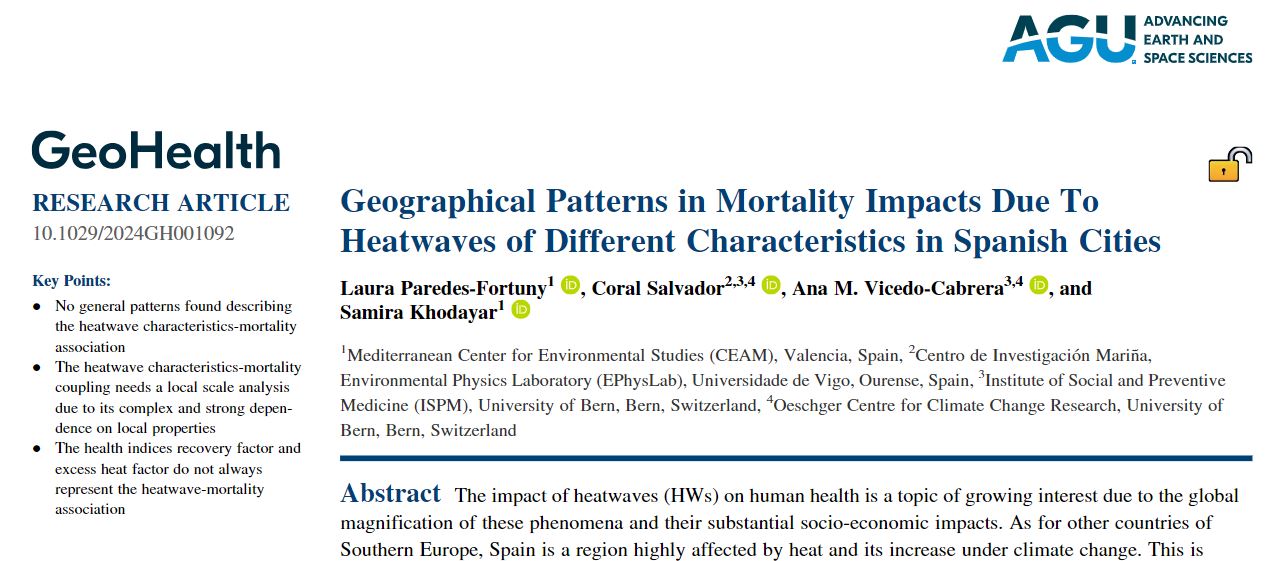
The research was carried out by Laura Paredes-Fortuny, Coral Salvador, Ana M. Vicedo-Cabrera, Carmen Iñiguez and Samira Khodayar, bringing together expertise in climatology, epidemiology and environmental health.
Publication:
Paredes-Fortuny, L., Salvador, C., Vicedo-Cabrera, A. M., Iñiguez, C., & Khodayar, S. (2026). Spatial Heterogeneity in Heat-Related Mortality in the Valencian Region: Implications for Climate Adaptation Beyond Administrative Boundaries. GeoHealth, 10, e2025GH001699.
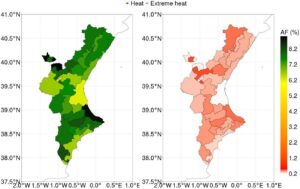
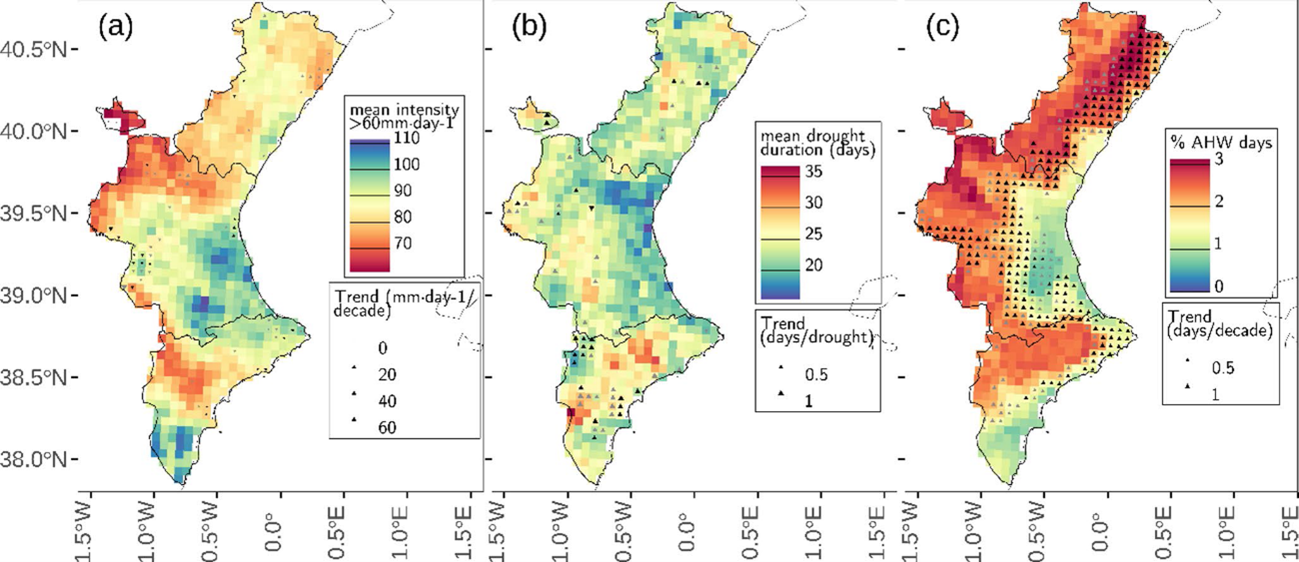
For the May–September period of 1975–2019, spatial distribution of the attributable fraction (AF) of summer mortality in the Valencian Region during heat days (HD, left) and extreme heat days (EHD, right), estimated using thermoclimatic-area-specific models.