News
Marine heatwaves in the Mediterranean are becoming increasingly intense and frequent, particularly when they overlap with extreme atmospheric heat events
- August 26, 2025
- Meteorology and Climatology
New findings from the Meteorology and Climatology Area shed light on the Mediterranean’s rapid warming, the shifting nature of marine heatwaves, and the factors fueling their intensification.
Among the lines of research carried out by CEAM’s Meteorology and Climate Area, a main research interest is the study of thermal extremes at the sea surface, particularly marine heatwaves (MHWs). These are defined as prolonged periods —lasting at least five days— in which the sea surface temperature (SST) exceeds a climatic threshold established in large regions.
In recent years, CEAM has developed a line of work focused on the thermal behaviour of the Mediterranean Sea, its evolution and its interaction with extreme atmospheric phenomena. This research has resulted in a series of four scientific articles, covering topics ranging from the general evolution of sea temperature to the physical mechanisms that explain the intensification of MHWs. The fourth and most recent study has just been published in the Nature group journal Communications Earth & Environment.
1.- The underlying trend: the sea is warming
The first study in the series analyses the evolution of sea surface temperatures in the Mediterranean over recent decades. The study highlights a clear and persistent increase in temperatures, especially during the summer months, which has accelerated over the last two decades. This progressive warming is the backdrop against which extreme phenomena such as MHWs emerge.
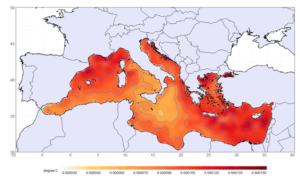
Mediterranean warming trend between 1982 and 2019
2.- Characterisation and intensification of MCOs
The second article in the series focuses on characterising marine heatwaves in the Mediterranean basin and analysing their historical evolution over the last 40 years. This study determined that at least 5% of the Mediterranean basin must be affected in order for an episode of anomalous SST warming to be considered an MHW. The results show an increase in the frequency, intensity and geographical extent of these extreme thermal events.
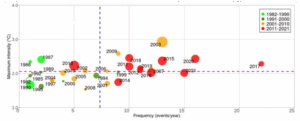
Annual average values of maximum intensity relative to the frequency of MHWs in the Mediterranean basin. The size of the dots indicates the average annual duration
3.- Double impact: when the sea and atmosphere coincide
The third study investigated the concurrence of MHW and atmospheric heat waves (AHWs). To this end, an innovative methodology was developed to identify and track both phenomena together in space and time. The analysis revealed that MHWs intensify significantly when they coincide with an AHW, while the characteristics of the latter are hardly altered.
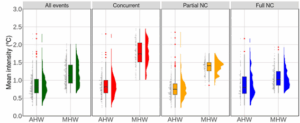
Distribution of the average intensity of MHWs and AHWs by groups according to the concurrence or non-concurrence of both phenomena
4.- Physical mechanisms: why MOCs intensify
The fourth and most recent article, published in the Nature group’s Communications Earth & Environment journal, delves into the physical processes that explain the intensification of MHWs during concurrence with AHWs. Through the analysis of energy flows between the sea and the atmosphere—such as solar radiation and latent and sensible heat fluxes—it was identified that, during concurrence, the latent heat flow from the sea to the atmosphere decreases considerably. This reduced energy loss favours heat accumulation in the ocean, thereby increasing sea surface temperature and MHW intensity. When the concurrence ceases, the system gradually recovers its normal energy exchange and the MHW loses intensity.
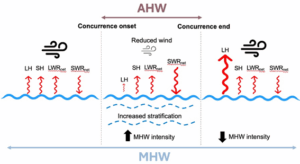
Conceptual diagram of the interaction between MHW and AHW with variations in energy (heat) flows in the sea-atmosphere system
This series of studies offers a comprehensive overview of how current climate impacts are transforming the thermal behaviour of the Mediterranean Sea, with a gradual shift towards a new normal of higher temperatures and more intense extreme events. These findings provide key insights for monitoring, analysing and potentially managing extreme events that affect both marine ecosystems and related human activities.