News
Aridity modulates grassland biomass responses to combined drought and nutrient addition
- May 21, 2025
- Forest Research
A recent study published in Nature Ecology & Evolution found that the sensitivity of grassland biomass to drought and nutrient addition is regulated by aridity.
A recent study published in Nature Ecology & Evolution found that the sensitivity of grassland biomass to drought and nutrient addition is regulated by aridity (https://doi.org/10.1038/s41559-025-02705-8), using experimental data from the NPK-Drought Network (https://www.bayceer.uni-bayreuth.de/npkd/index.php?lang=en) including 26 sites in 9 countries (Fig. 1).
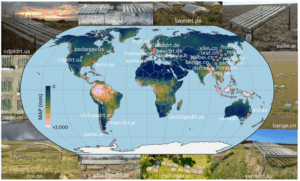
Fig. 1: Distribution map of the NPK-D Network. Spatial distribution of NPK-D Network sites (n = 26) with their corresponding codes, superimposed on a map showing mean annual precipitation (1981-2022). Together with the global map, example photographs provided by the co-authors illustrate the experimental design at selected sites.
The research was carried out by an international team of 42 institutions and 54 co-authors, including Alejandro Valdecantos from the Joint Unit University of Alicante-CEAM Foundation and David Salesa, pre-doctoral researcher at the CEAM Foundation.
The authors found that the effects of drought and nutrient addition on grassland productivity vary between ecosystems, modulated mainly by environmental conditions, in particular aridity. In specific terms, nutrient addition mitigates the effects of drought more effectively in arid grasslands, while its effects are reduced in humid regions or on nitrogen-rich soils. In areas with high rainfall variability, grassland productivity shows weaker responses to both nutrient inputs and drought. In addition, high diversity grasslands show higher productivity increases under nutrient enrichment, but also experience steeper declines under drought conditions (Fig. 2).
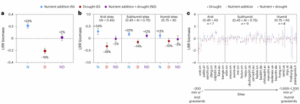
Fig. 2: Effects of nutrient addition and drought application on the log ratio of biomass production (treatment biomass/biomass under ambient conditions).
This study demonstrates that drought and nutrient addition jointly regulate grassland productivity and that aridity, soil nitrogen, rainfall variability and biodiversity critically determine ecosystem responses to climate change and human nutrient inputs. These findings establish a critical theoretical basis for developing climate adaptation strategies and advancing sustainable ecosystem management under global change.