News
Mediterranean marine heatwaves become more intense when an atmospheric heat wave coincides at the same time and area
- January 9, 2025
- Meteorology and Climatology
A new study by the CEAM Meteorology and Climatology area has been published in the high impact journal Communications Earth & Environment by the Nature group.
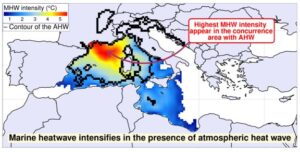
Intensified Warming in the Mediterranean: The Impact of Concurrent Heatwaves
Over the past two decades, the Mediterranean Sea has undergone accelerated warming, a trend strongly linked by the scientific community to anthropogenic climate change. One striking consequence of this warming has been the increasing frequency and intensity of both marine and atmospheric heatwaves (MHWs and AHWs). The interaction between these phenomena, or at least their spatiotemporal overlap, has also risen. Building on our ongoing research into climate change impacts in the Mediterranean—particularly extreme events—we have explored the effects of simultaneous marine and atmospheric temperature extremes.
Key Findings from Our Analysis
Our results reveal a clear upward trend in the concurrence of extreme temperature events in the Mediterranean Sea over recent decades, while standalone events have become progressively less frequent. The interaction of MHWs and AHWs alters the characteristics of these events, especially for MHWs, largely due to shifts in air-sea heat fluxes. While AHWs do not exhibit significant changes in intensity, concurrent MHWs show notable intensification, with average temperature increases of 0.7–0.8°C compared to non-concurrent events.
The most profound impact of this concurrence is the intensification of MHWs, observed in both their average and peak intensity, as well as the speed of their intensification. This heightened intensity appears to be a transient local phenomenon within the areas where MHWs and AHWs overlap.
Implications for Climate Change and Mediterranean Biodiversity
The observed intensification of MHWs due to concurrence adds a layer of complexity to the long-term trend of warming in the Mediterranean, which is already driven by climate change. This localized intensification has significant implications for the region’s climate and biodiversity. As the frequency of concurrent HWs is expected to increase, their compounded impacts could exacerbate stress on marine ecosystems and coastal communities.
To better understand and address these challenges, further research is needed to evaluate the influence of local intensification on the broader trends of MHWs. By integrating these findings into climate change impact assessments, we can improve strategies for mitigating risks and protecting the Mediterranean’s unique and vulnerable ecosystems in the face of a warming world.
Reference
Pastor, F., Paredes-Fortuny, L. & Khodayar, S. Mediterranean marine heatwaves intensify in the presence of concurrent atmospheric heatwaves. Commun Earth Environ 5, 797 (2024). https://doi.org/10.1038/s43247-024-01982-8